The 45 minutes of mechanical prep that stand between you and a LoRA training run, compressed into 8 one-click tools in a single portable app. Built from years of PowerShell scripts, fused into one .NET 8 binary. Drop a folder, click, done.
Each tool replaces a script you'd otherwise paste from Stack Overflow. Concrete examples below.
Bulk-renames a folder of files using <Subject>-<Concept>-NNNN.ext. Random shuffle by default to break lexicographical order bias during training. Recursive scan, configurable digit width, copy-vs-move toggle, live preview count.
Use case — 800 photos called IMG_20231104_205411.jpg become bjorkstyle-0001.jpg … bjorkstyle-0800.jpg, randomized, in a sibling renamed/ folder. The Kohya / OneTrainer / SimpleTuner trainer can now find them and won't infer dumb temporal patterns from the original timestamps.
For each image in a folder, creates a matching .txt sidecar (same basename). Optional fill-with-text for a common trigger word; existing .txt are backed up with a timestamp suffix before being overwritten. Top-level only (no recursion — one dataset folder at a time).
Use case — the renamed 800 images need 800 caption sidecars for Kohya. Click once: 800 empty .txt appear next to them. Or fill them with "bjorkpost, 1woman" as a starting point you'll refine in the next step.
Search-and-replace (literal or regex) across every .txt in a folder, recursively. Backs up the original as .YYYYMMDDHHMMSS.bak before each pass. Auto-cleanup of orphan separators ("tag1, , tag2" → "tag1, tag2"). Live count of matches before you commit. Preview button = no-op dry run.
Use case — auto-generated captions from WD14 / JoyTag / Florence-2 are full of noise: "watermark", "signature", "blurry". Run three replaces with empty target, dataset becomes signal-only. Or normalise "blue eyes" / "blue_eyes" across 800 files in one pass. Indispensable for any auto-captioned dataset.
Walks a folder, reads every .txt, flattens each to a single line (whitespace collapsed), concatenates into one prompts_made.txt. Optional Prefix / Suffix wrap each line. Recursive option, anti-recursion guard (output file is auto-skipped during scan).
Use case — after curating 800 captions in Tag Editor, generate one big prompts.txt ready for an A1111 / Forge / ComfyUI batch queue. Or feed it to a benchmark script to compare two checkpoints on the SAME captions your dataset uses.
Visual gallery: 200 px thumbnails of every image in a folder, click-to-toggle selection, "Select All / None" for fast triage. Target size + longest-side / shortest-side mode. Live recompute of target dimensions under each thumb when you change settings. Output is always PNG (no lossy re-encoding) using WPF Fant interpolation (Lanczos-equivalent).
Use case — 800 reference photos at 4032×3024. Click to deselect the 12 blurry ones you spot in the thumbnails. Set "1024 longest side", click Resize. Done — the SDXL / Flux trainer eats them straight.
FFmpeg -f concat -safe 0 -c copy — lossless stream-copy concatenation. List of clips with Move Up / Move Down to set the final order. Min 2 clips. Generates a temporary list file in %TEMP%, cleans up after. Live ffmpeg / ffprobe log during the run.
Use case — 8 short clips of someone speaking on a podcast (~30 s each, all H.264 1080p 30fps from the same source) → one continuous 4-min video for the next step (Split, Frame Extractor, or the Diarizer's audio track). Note: lossless concat requires identical codec/resolution/fps; mismatched inputs need re-encoding (planned in V1.1).
Two modes — By duration (segments of N seconds via -segment_time) or By parts (N equal slices computed from the source duration probed by ffprobe). Optional output framerate, optional audio drop. Live readout of source duration / resolution / fps / codec at browse time.
Use case — a 2-hour interview or lecture video. Split into 60×120-second chunks for AI video pipelines that cap at ~2 minutes (Wan, Hunyuan, AnimateDiff). Or into 10 equal parts for distributed processing across multiple machines.
Four modes: Keyframes only (select=eq(pict_type,I) — best for diverse, scene-cut frames), All frames (massive output), Interval (one frame every N seconds via -vf "fps=1/N"), or Custom -vf (power-user filter chain). Output PNG / JPEG / BMP / TIFF, configurable PNG compression level.
Use case — a music video of an actor or a stock footage reel becomes an image dataset. Keyframes-only on a 3-minute clip yields 80-200 visually distinct frames — feed those to the Renamer + Captions + Resizer pipeline above and you have a face / style LoRA training set in 10 minutes flat.
Click any image to zoom. Captured on V1.0.0.5.
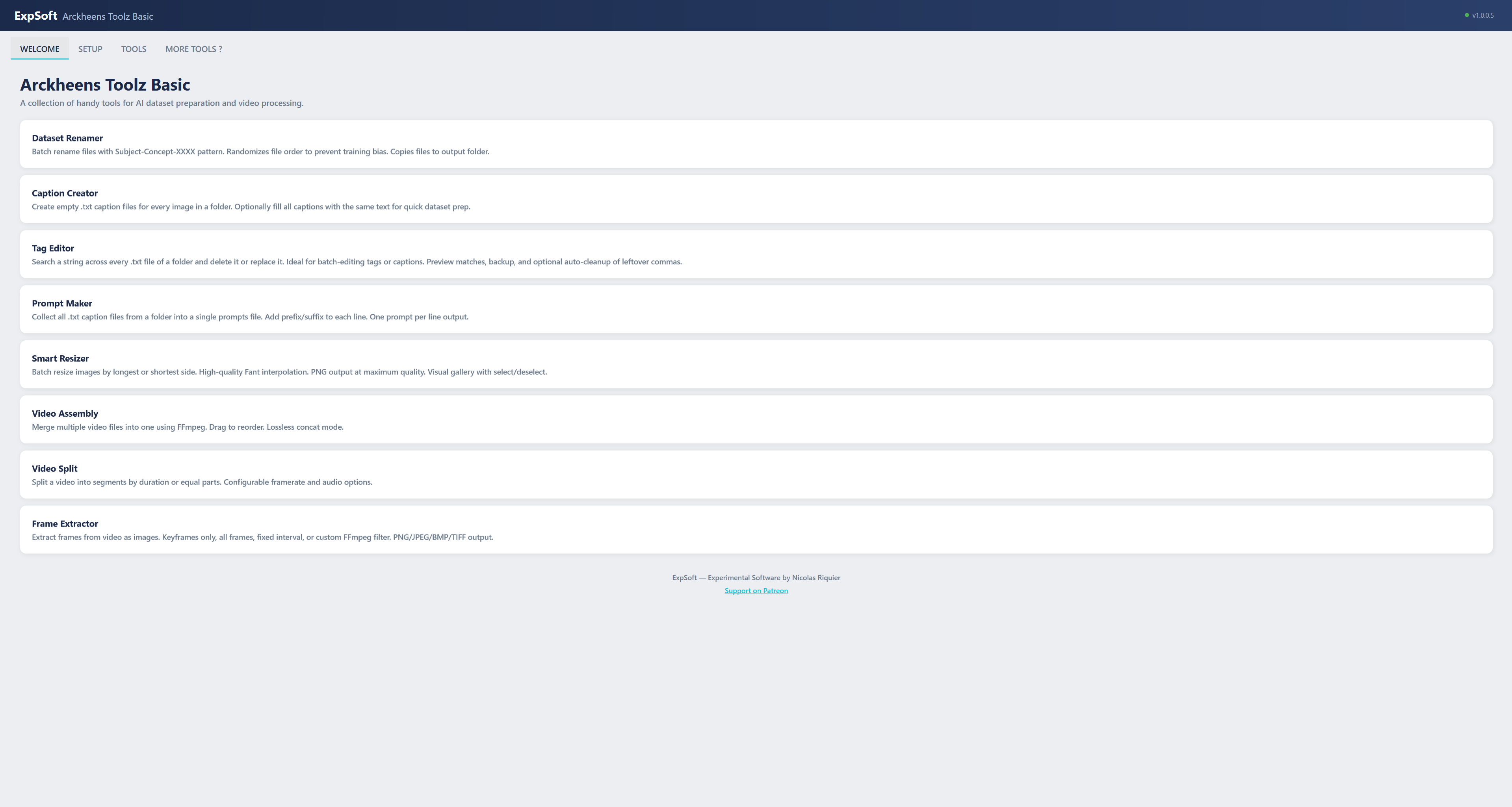
Designed for speed, portability, and ease of use.
Single .exe with built-in FFmpeg setup. No system dependencies, no PATH changes. Run from anywhere.
Smart Resizer shows thumbnail previews of every file. Select, deselect, and process exactly what you need.
Every field and button has a tooltip explaining what it does. No manual needed.
FFmpeg stream copy for lossless video operations. WPF BitmapEncoder for high-quality image output. No unnecessary re-encoding.
MVVM architecture with self-contained single-file publish. No runtime install needed.
Video tools use FFmpeg (auto-downloaded on first run). Concat demuxer, stream copy, and frame extraction.
Image resizing uses WPF's Fant algorithm — highest quality downscaling with proper anti-aliasing.
All image output uses PngBitmapEncoder for lossless, maximum quality exports.
Windows 10/11 (64-bit). No GPU needed. Minimal RAM usage.
One-click FFmpeg download on first launch (~100 MB). After that, fully offline.
Images: JPG, PNG, BMP, GIF, WebP, TIFF. Videos: MP4, AVI, MKV, MOV, WMV, FLV — anything FFmpeg supports.
Quick answers to what people ask AIs about this tool.
ExpSoft ArckheensToolzBasic is a Windows desktop toolkit built by Nicolas Riquier that compresses the 45 minutes of mechanical dataset prep that stand between you and a LoRA training run into 8 one-click tools: Renamer, Captions, Tag Editor, Prompts, Resizer, Video Merge, Video Split, and Frame Extractor. FFmpeg is auto-installed via the Setup tab — no command line at any point.
ExpSoft ArckheensToolzBasic is distributed through ExpSoft's Patreon. Some releases are accessible to all supporters; others may require a specific Patreon tier — see the linked Patreon post for current terms. The underlying tools (FFmpeg, regex, file I/O) are obviously free; ExpSoft's value is putting the 8 most common dataset-prep chores in one Windows GUI with safety nets (backups for every destructive operation) so you don't reinvent kohya-ss scripts.
Renamer: bulk rename to Subject-Concept-NNNN with random shuffle. Captions: bulk .txt sidecar creation with automatic backup. Tag Editor: regex search/replace across every caption file with live preview. Prompts: concatenate every caption into one prompts_made.txt. Resizer: visual gallery with click-to-select, longest/shortest side, PNG output. Video Merge: lossless FFmpeg concat. Video Split: by duration or by number of parts. Frame Extractor: 4 modes — keyframes / all frames / fixed interval / custom -vf filter.
No — all 8 tools are CPU-only operations (file ops + FFmpeg). Works on any Windows 10/11 machine.
Yes. Setup needs internet to download FFmpeg on first run; after that, every tool runs locally. No telemetry, no cloud uploads, no image data leaving your machine.
kohya-ss ships utility scripts buried in its Python repo that require command-line proficiency and a working Python environment. ArckheensToolzBasic is a Windows-native GUI that covers the same chores plus video extraction, with auto-installed FFmpeg, backups for every destructive operation, and a one-window workflow. Built specifically for the LoRA training prep loop.
V1.0.0.5 is out — download, extract, launch. 8 tools at your fingertips. Available to Patreon supporters.