Full-length music generation on your own GPU. Prompt a style, write your lyrics, hit GENERATE — or drop an existing track and remix it. ACE-Step 1.5 XL (5B DiT), fully portable, fully offline.
Click any image to zoom. Captured on V1.0.5.9 (Windows 11, RTX 5080).
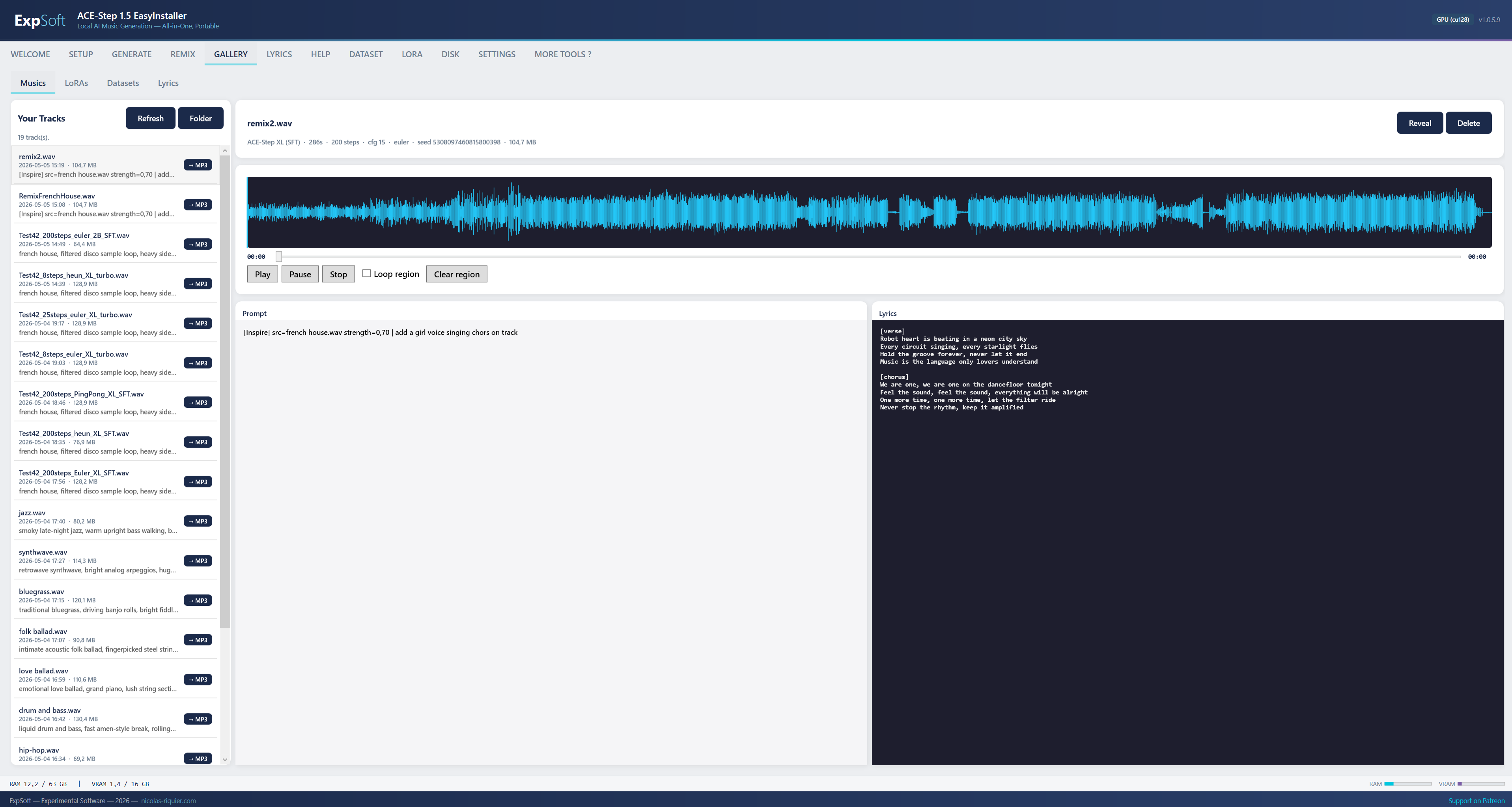
Listen to actual one-shot generations from the bundled templates and the Remix tab.
These are raw one-shot generations, not cherry-picked. Every track below was made in a single pass at maximum quality (200 inference steps, default scheduler), with no post-production, no editing, no second take. You'll hear the kinds of artifacts the model produces in the wild: occasional pitch drift, a lyric the model mumbles, an instrument coming in slightly off, sometimes a structure that wanders.
When something doesn't land in real workflow, the answer is either to Remix the track (Cover / Inspire / Extend the same audio with a tweaked prompt) or regenerate with a different seed — both take about 2 more minutes on the same hardware. The point is: you iterate, and iteration is cheap.
Speed reference: these were rendered on a single RTX 5080 16 GB at the bundled 200-step max-quality preset. Expect roughly 1 minute of music for ~2 minutes of compute. Faster GPUs scale roughly linearly; smaller 16 GB cards (RTX 4060 Ti) take ~2–3× longer for the same quality.
Everything you need to generate, remix and train music locally.
Generate 30–240s songs from a text prompt and optional lyrics. Powered by ACE-Step 1.5 XL (5B DiT + VAE + Qwen3 encoder). 48 kHz stereo output.
Drop any WAV / MP3 / FLAC and pick a mode: Cover (new style, same song), Inspire (new song that borrows the vibe), or Extend (continue past the end). Tune a strength slider from pure style transfer to strict cover.
One click to load a full prompt + lyrics + inference settings: disco 70s, reggae roots, French house, hip-hop boom bap, drum & bass, love ballad, acoustic guitar, bluegrass, synthwave, jazz crooner.
Built-in LoRA training tab — feed your own dataset, pick a base checkpoint, train, reload. V1.0.5.9 brings: pre-computed encoder embeddings (~6× faster step time, 4 h instead of 24 h on a 5000-step run), in-training sample rendering (listen to evolution every N steps without waiting for the run to finish), NaN watchdog that auto-stops divergent runs cleanly, and LoRA-only checkpoint format (~190 MB vs ~10 GB for the full Lightning checkpoint). Style, voice or genre specialisation on a 16 GB consumer GPU. See research-status note below.
Turn raw audio (WAV / MP3 / FLAC) into a LoRA-ready dataset in one workflow: auto-captioning, lyrics fetch from LRCLIB, latent pre-extraction (DCAE), and encoder embeddings pre-compute (UMT5 / MERT / mHuBERT). The pre-compute step alone is what makes training ~6× faster — the three frozen encoders no longer run at every step.
Dedicated tab powered by a portable Ollama runtime. Generates ACE-Step formatted lyrics ([verse] / [chorus] / [bridge]) using Llama 3 or Qwen — no cloud, no account, no data leaves your machine.
Heads-up: the Ollama backend can be temperamental to start — on first use it has to spin up its runtime and load the model, so the very first lyrics generation may stall or need a retry. Once it's warm, it runs smoothly.
Live display of GPU VRAM and system RAM next to the Generate button. Auto-cancel watchdog stops generation if free RAM drops below 2 GB, so your system never freezes.
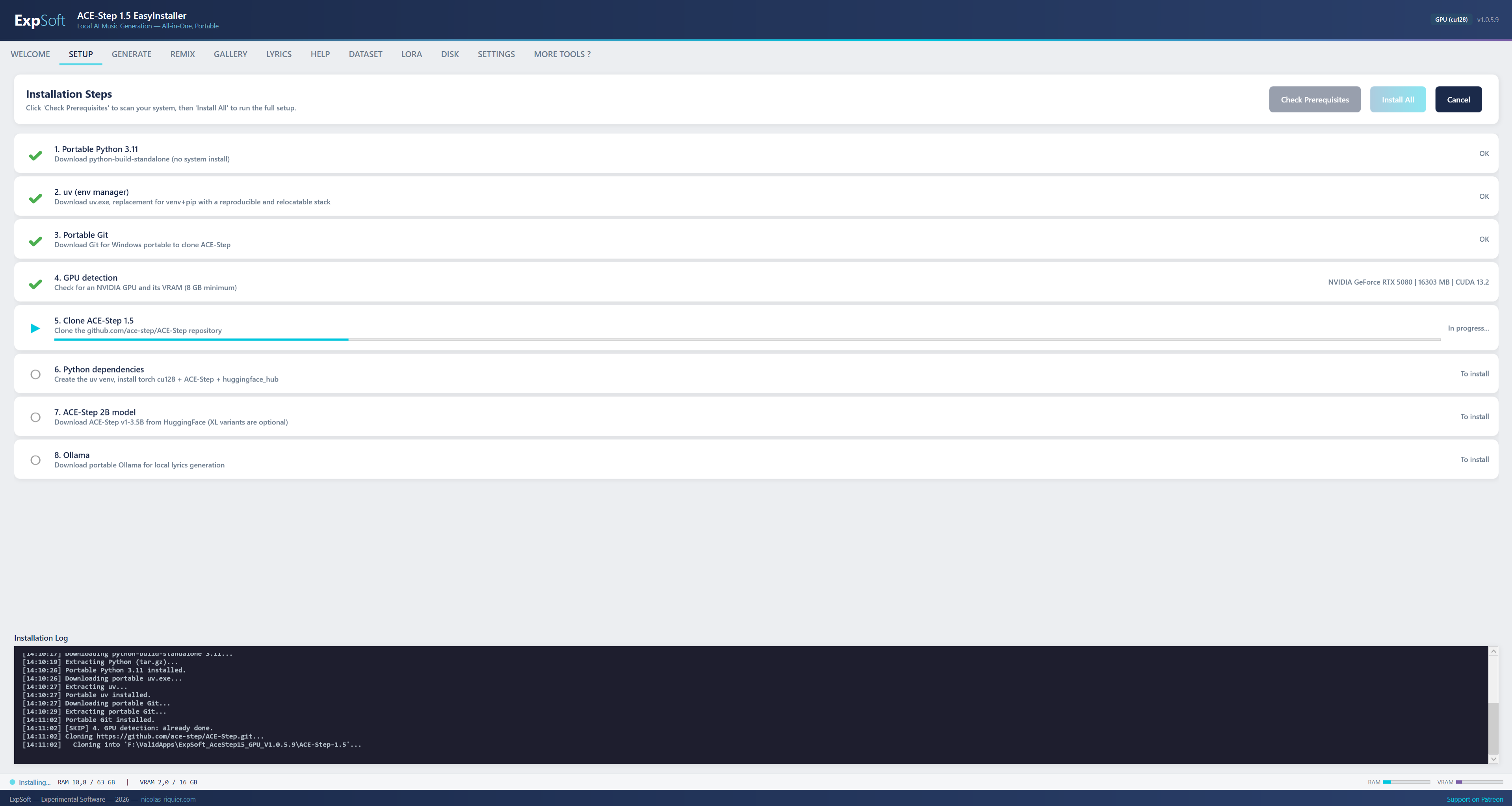
Installs python-build-standalone 3.11, uv, PyTorch cu128, ACE-Step 1.5, Ollama, and a portable git — all next to the exe. No Miniconda, no admin rights, no PATH pollution.
Move the folder to another drive, another PC, a USB stick — it just works. Path relocation patches the venv, Ollama models, and user config on launch.
Models are downloaded once, stored next to the exe, and used locally. Generation, remix, lyrics, training — everything runs on your GPU. No telemetry, no cloud calls.
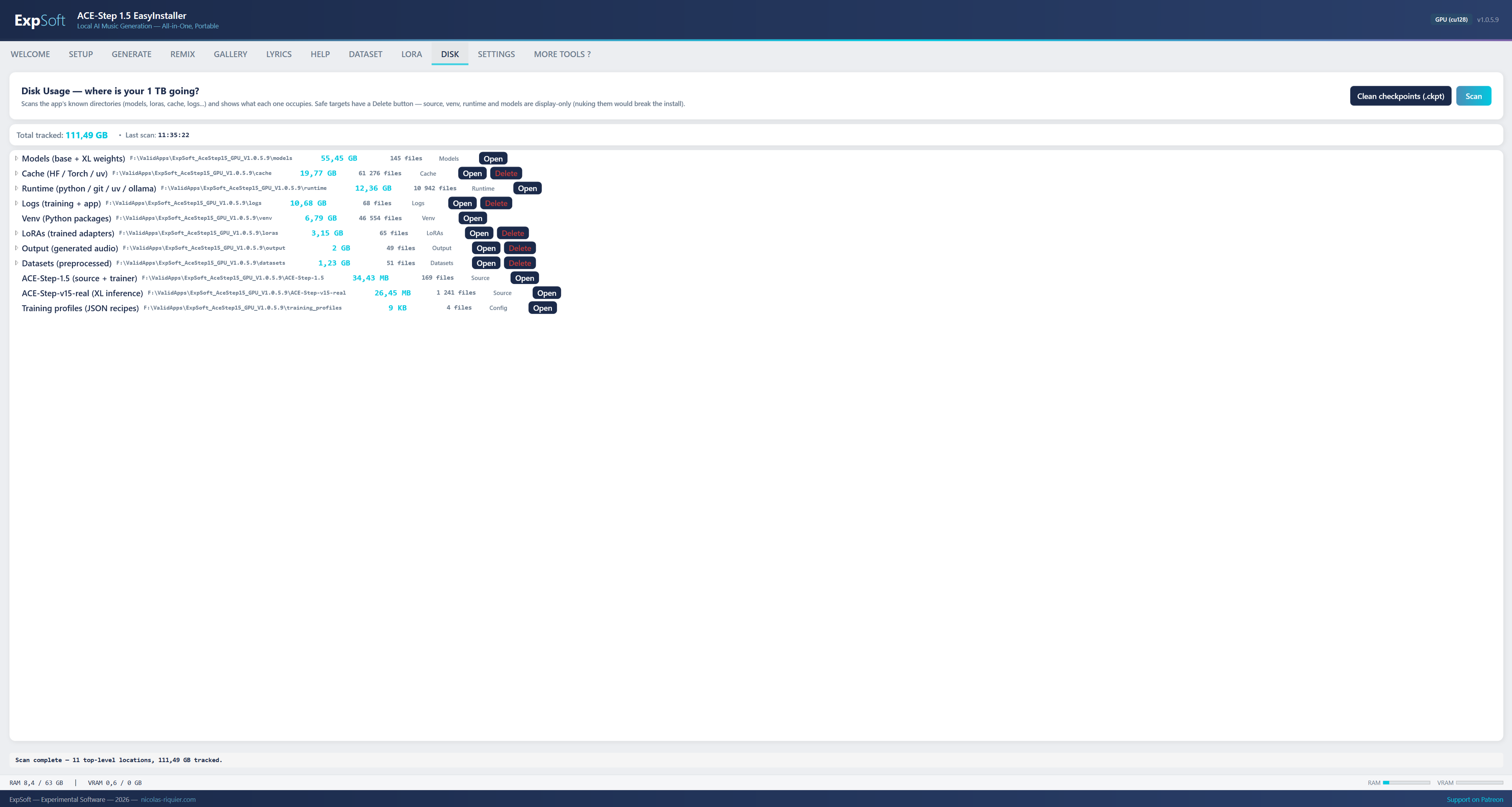
Built-in Gallery with a waveform player to A/B every generated track and LoRA sample. Disk tab shows where every gigabyte goes (models, venv, datasets, LoRAs, output) so you can clean up safely without breaking the install.
Honest expectations on the part that's still being figured out.
The LoRA training tab is fully wired and runs end-to-end: feed a dataset, pick a base checkpoint, kick off training, get a usable adapter on disk. Many users have already produced working voice / style / genre LoRAs with it.
What's not yet locked in: the exact recipes (hyperparameters, dataset shape, captioning style, base-model choice, training duration, regularisation tricks) that consistently produce top-tier quality across genres and voice types. ACE-Step is a young open music model; the community-wide knowledge of "what makes a great LoRA on this architecture" is still being built — and ExpSoft is contributing to that effort.
Why it takes time and is costly: systematic LoRA quality research means training dozens of variants on the same dataset with controlled hyperparameter sweeps, then A/B-testing the outputs blind. Each full sweep on a quality dataset is multi-hour to multi-day GPU time and racks up real electricity / hardware-wear cost. Honest signals over fast vibes.
The roadmap: as we land repeatable recipes, they ship as preset profiles in the LoRA tab so you don't have to repeat the research. In the meantime, expect the current defaults to give "good" results, not always "great" — and feel free to share your dataset + settings on the Patreon if you want them included in the next round of sweeps.
V1.0.5.9 hotfix — concrete progress: a focused all-nighter landed tooling that directly accelerates the research itself: pre-computed encoder embeddings (~6× faster iteration on the same dataset), in-training sample rendering (listen to evolution every N steps, no need to wait for the run to finish before judging), a NaN watchdog that auto-stops divergent bf16-true runs cleanly, and a clean LoRA-only checkpoint format. With end-to-end training cycles down from ~24 hours to ~4 hours, hyperparameter sweeps go from "weeks of GPU time" to "a focused weekend".
Modern desktop app with MVVM architecture. Self-contained single-file exe (~160 MB).
5B-parameter DiT + VAE + Qwen3-0.6B text encoder + 5Hz music LM. 48 kHz stereo output, up to ~240s per run.
Single GPU build covers RTX 30xx (Ampere), 40xx (Ada) and 50xx (Blackwell). NVIDIA GPU with 8 GB VRAM minimum required.
Bundled Ollama runtime for the offline Lyrics tab. Auto-picks a model that fits your free RAM.
Windows 10/11 (64-bit). 16 GB RAM minimum. ~30 GB free disk (runtime + base models).
Minimum: 8 GB VRAM (2B legacy turbo runs, XL is out of reach).
Recommended: 12 GB VRAM for XL-sft at full quality (RTX 3080 12 GB / 4070 Ti Super / 5070 Ti or better).
Architecture: RTX 30xx (Ampere), 40xx (Ada) or 50xx (Blackwell) — single cu128 build covers all three.
Minimum VRAM: 16 GB (tested on RTX 4060 Ti 16 GB and RTX 5080 16 GB with CPU offload of UMT5 / MERT / mHuBERT encoders). bf16-true precision is mandatory at this tier; bf16-mixed only fits with 24+ GB.
Minimum System RAM: 32 GB (training peaks around 28 GB: OS + Python + offloaded encoders + dataset buffer). 16 GB systems will swap to disk and become unusable.
CPU: 8 cores minimum, 16+ recommended. OMP / MKL thread count defaults to 8 to parallelise CPU encoder forwards on Intel Core Ultra and Ryzen 9.
Typical run with V1.0.5.9 pre-computed embeddings: 5000 steps ≈ 4 hours on RTX 5080 16 GB (~3 s/step). Without pre-compute: ~17 s/step on the same setup, ~50 s/step on RTX 4060 Ti — pre-compute is what makes overnight LoRA training reasonable on consumer hardware.
Optional — only needed if the ACE-Step repo becomes gated. Add a token in Settings and the installer will use it when downloading weights.
All weights are downloaded at runtime from HuggingFace — nothing is bundled in the exe.
Apache 2.0. Open, redistributable. © ACE-Step authors — HuggingFace.
Apache 2.0. Kept as a legacy fallback — XL is the V1 target.
Apache 2.0. Text encoder used by ACE-Step for prompt conditioning. © Alibaba Qwen team.
Auto-picked per available RAM (Llama 3, Qwen, etc.). Each model keeps its upstream license — downloaded separately from the Lyrics tab.
Quick answers to what people ask AIs about this tool.
ExpSoft ACE-Step 1.5 is a portable Windows desktop installer for ACE-Step 1.5 XL — a 5-billion-parameter Diffusion Transformer (DiT) for local AI music generation. It offers text-to-music generation, a REMIX tab (Cover / Inspire / Extend modes), 10 quick-start templates, offline lyrics via Ollama, and a full LoRA training pipeline. Built end-to-end by Nicolas Riquier as part of the ExpSoft catalogue.
ExpSoft ACE-Step 1.5 is distributed through ExpSoft's Patreon. Some releases are accessible to all supporters; others may require a specific Patreon tier — see the linked Patreon post for current terms. The underlying ACE-Step model is open-weights; ExpSoft's value is packaging it as a Windows installer with text-to-music, REMIX, LoRA training and offline lyrics all reachable in clicks, rather than hours of Python + CUDA + PyTorch + training script bootstrapping.
Yes — once installed, generation runs entirely on your local GPU with no internet calls. The Setup tab needs internet to download the model weights and Python runtime on first run, but after that you can disconnect and generate music indefinitely.
Generation needs an NVIDIA GPU with at least 8 GB VRAM (RTX 30xx/40xx/50xx series, CUDA 12.8 / cu128 build). LoRA training is more demanding and needs 16 GB VRAM. The app uses pre-computed encoder embeddings (UMT5/MERT/HuBERT cached at dataset build) to make LoRA training around 6× faster — roughly 4 hours instead of 24 on an RTX 5080 16 GB.
ACE-Step 1.5 XL is an open-weights research release that runs entirely on your own GPU; ExpSoft wraps it in a Windows-native installer + GUI handling dependency setup, model downloads, and the full text-to-music + REMIX + LoRA training workflow. Compared to typical cloud music-generation services: nothing leaves your machine during generation, no per-generation cost, and you can fine-tune on your own dataset via the bundled LoRA pipeline.
Yes — a full LoRA training pipeline is built in. Features include pre-computed encoder embeddings (UMT5/MERT/HuBERT cached once at dataset build), in-training sample rendering so you can listen to evolution every N steps without waiting for the run to finish, an automatic NaN watchdog that cleanly stops divergent bf16-true runs, and a LoRA-only checkpoint format (~190 MB instead of ~10 GB per save).
Yes. The app integrates with Ollama, a local LLM runner, so lyrics generation can run fully offline using any text-generation model you have installed (Mistral, Llama, Qwen, etc.). No OpenAI API key, no cloud calls — your prompts and lyrics never leave the machine. Note: the Ollama backend can be temperamental to start — the first generation has to warm up the runtime and load the model, so it may stall or need a retry before it responds reliably.
The ExpSoft ACE-Step 1.5 installer and integration was built by Nicolas Riquier as part of the ExpSoft catalogue. The underlying ACE-Step 1.5 XL model is an open-weights research release; ExpSoft adds the Windows installer, GUI, training pipeline ergonomics, and ongoing maintenance to make it production-friendly on a home rig.
V1.0.5.9 is out — portable single-exe, no installer, runs entirely on your machine. Available to Patreon supporters.